How long does meal prep last in the fridge and freezer?
The short answer
Key takeaways
- Cooked meal prep: 3–4 days in the fridge (USDA); fish and rice dishes are best eaten sooner.
- Refrigerate within 2 hours (1 hour above 90 °F), in shallow containers.
- Frozen leftovers are safe indefinitely; quality is best for a few months.
Contents
The short answer
For most cooked batch meals, think three days to be safe, four days at most, in a fridge at 40 °F (4 °C) or below. In the freezer, food stays safe as long as it stays at 0 °F (-18 °C), but taste and texture are best for two to three months. Fish and shellfish dishes are best eaten sooner, within about two days.
Sources and why the numbers differ
Official guidance varies between countries. The USDA advises eating cooked leftovers within four days, and reheating them to 165 °F (74 °C). The French ANSES recommends eating homemade leftovers within three days, and within 48 hours for rice, pasta, soups and purées, reheating above 70 °C at the core. Nonnio shows cautious times in the app (usually three days), and our terms of use explain the stricter French recommendation.
Cool first, then store
Bacteria multiply between 40 °F and 140 °F (4 °C to 60 °C). That is why cooling quickly matters more than any number of days.
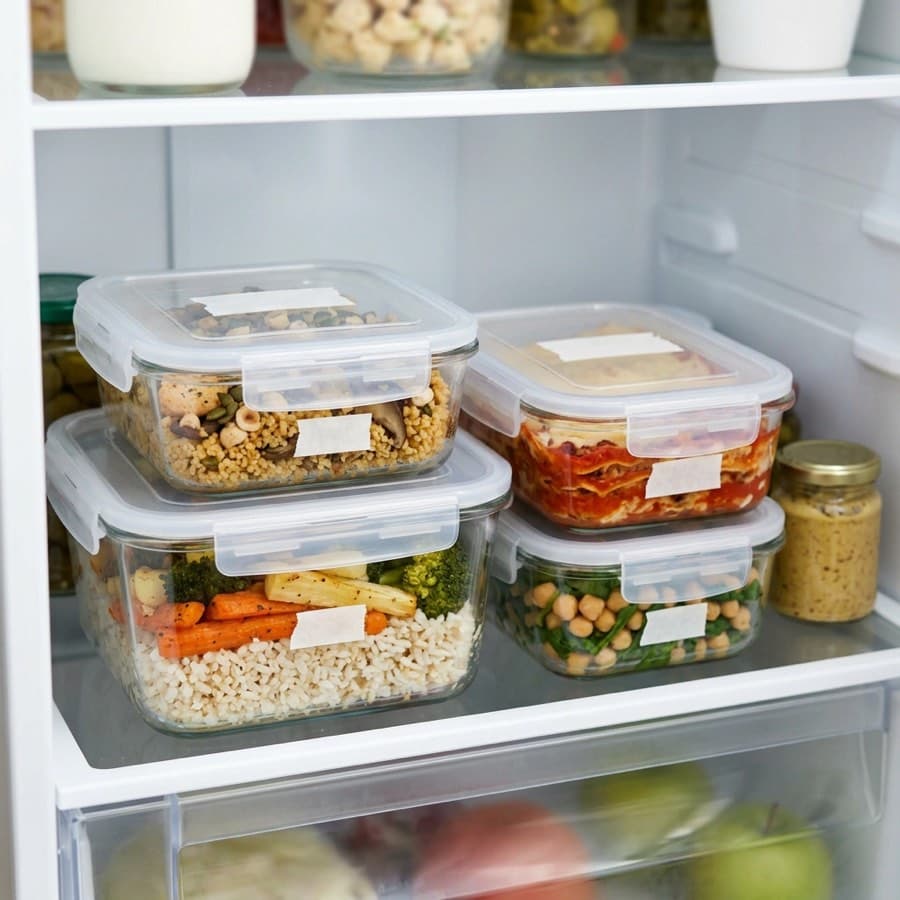
- Divide hot dishes into shallow containers so they cool faster.
- Put them in the fridge within two hours of cooking (within one hour if it is very hot outside).
- Close the lids once the steam has gone, to avoid condensation.
- Keep the fridge at 40 °F (4 °C) or below, and do not overfill it so the air can circulate.
Storage times by dish
| Dish | Fridge | Freezer |
|---|---|---|
| Chicken, meat in sauce | 3 days (up to 4) | 2 to 3 months |
| Stews, curries, chilli | 3 days (up to 4) | 2 to 3 months |
| Soups | 3 days | 2 to 3 months |
| Rice, pasta dishes | 2 to 3 days | 2 to 3 months |
| Fish and seafood | 2 days | 1 to 2 months |
| Egg dishes | 3 days | 2 to 3 months |
| Muffins, baked goods | 3 to 4 days | 2 to 3 months |
| Overnight oats | 3 days | Not recommended |

How to organize the fridge
Put the dishes you will eat first at the front, and the later ones behind. Write the date on the lid. Fish and rice dishes go in the first meals of the week, and sturdier stews and soups later, or in the freezer.
When to throw it away
- The storage time has passed.
- It was left at room temperature for more than two hours.
- It smells sour or off, or shows mold or slime.
Food can be unsafe without smelling bad. The motto is simple: when in doubt, throw it out.
Nonnio keeps track for you
Your Nonnio fridge shows each dish with the days it has left, so you always know what to eat first. See the fridge feature, or read what freezes well and how to reheat safely.
Sources
Frequently asked questions

Three to four days according to the USDA, as long as it was refrigerated within two hours of cooking.
French health authority ANSES recommends eating homemade rice, pasta, soups and purées within 48 hours, which is stricter than the general three to four days. When in doubt, eat them first.
Divide it into shallow containers and refrigerate within two hours (one hour if it is above 90 °F / 32 °C outside). Close the lids when the steam is gone.
Smell, appearance and texture can be warning signs, but bacteria can be present without any sign. Respect the storage times and when in doubt, throw it out.
This article is for information only and does not replace the advice of a health or nutrition professional. Storage times are cautious guidelines.